
The Workshop Diary17 June 20255 min read
How Interior Design Supports Infection Control in Hospitals
KAPCHER Team
KAPCHER Architecture | Interiors
HealthcareDesignSafety

Designing healthcare environments that are both beautiful and functionally safe — how thoughtful material choices and spatial planning reduce the spread of infection.
When we talk about hospital design, the conversation typically centres on efficiency, patient flow, and clinical adjacencies. But increasingly, interior designers are being asked to think about something less visible — the role of material surfaces, spatial geometry, and environmental controls in reducing the transmission of pathogens.
Healthcare-associated infections (HAIs) cost health systems billions of dollars annually and cause immeasurable patient suffering. The built environment cannot eliminate this risk entirely, but smart design choices can significantly reduce it.
Material Selection Is Everything
In a clinical setting, every surface is a potential vector. Wall cladding, flooring, furniture, and hardware must all be selected with infection control in mind — not just aesthetics. At KAPCHER, we specify antimicrobial surfaces including copper-alloy hardware, non-porous solid surface materials for countertops, and seamless vinyl or epoxy flooring systems that eliminate grout lines where microbes can accumulate.
“A hospital room isn't just a room — it's a clinical instrument. Every finish decision is also an infection-control decision.”
— KAPCHER Design Lead
Spatial Planning and Airflow
Beyond surfaces, spatial planning plays a critical role. The positioning of hand-hygiene stations at zone transitions — between the corridor and the patient room, between the clean and soiled utility zones — is one of the most evidence-backed infection control interventions. When we design healthcare spaces, we place washbasins not where they are architecturally convenient, but where clinicians will actually encounter them as a natural part of their workflow.
Negative pressure isolation rooms, HEPA filtration corridors, and careful attention to the direction of airflow between clean and contaminated zones are all HVAC considerations that shape the interior layout from the very first sketch.
Designing for Cleanability
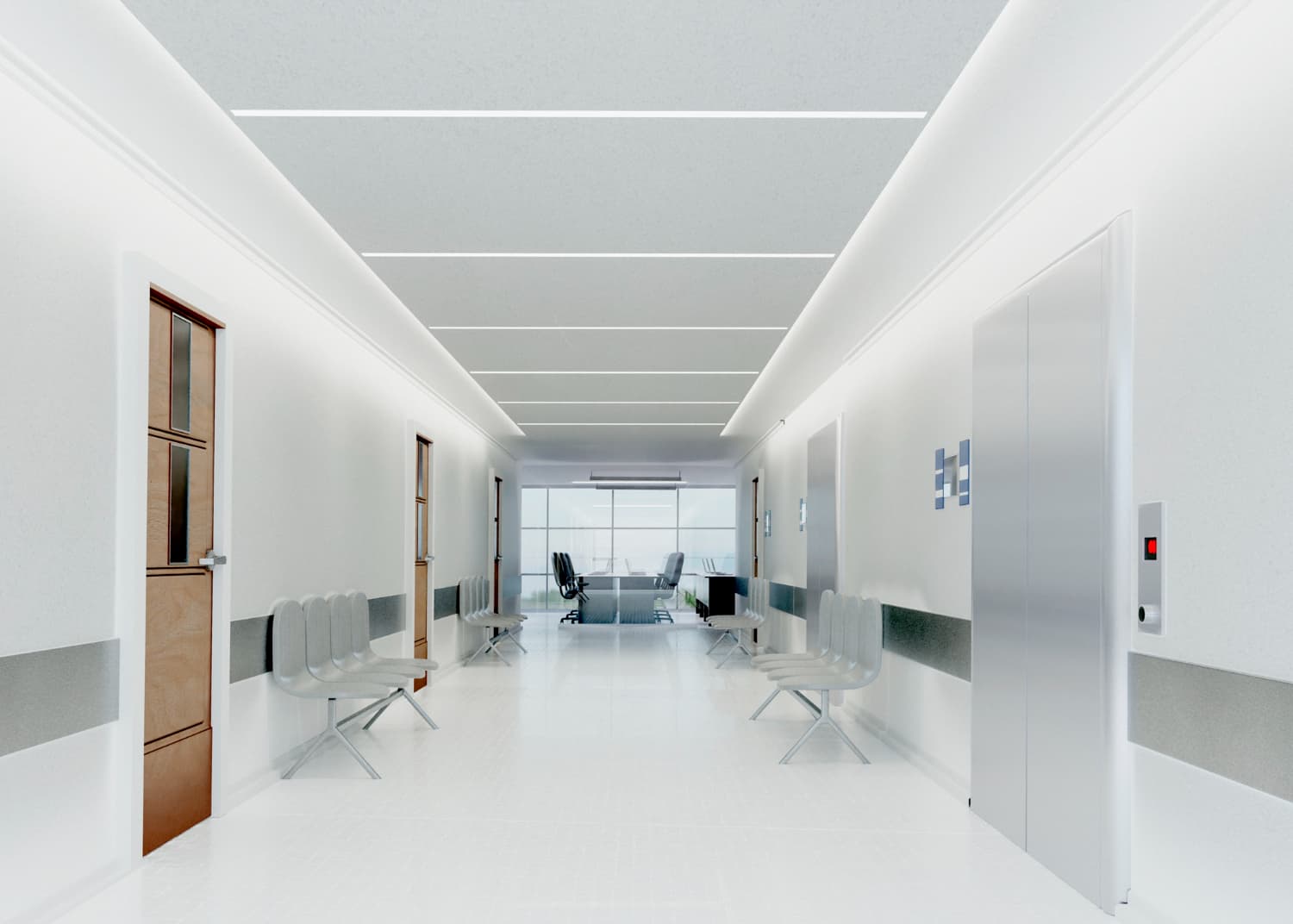
One principle guides our healthcare interiors above all others: design for the cleaner, not just the clinician. If a surface can't be wiped down quickly and completely by a housekeeping team working under time pressure, it's the wrong surface for a hospital. This means eliminating complex joinery, exposed screws, recessed ledges, and decorative mouldings that trap dust and resist disinfectant.
It also means rethinking furniture. Traditional upholstered chairs in waiting areas are infection-control nightmares. We specify wipe-clean vinyl or moulded seating with minimal crevices, while using warm lighting and careful colour palettes to maintain a sense of comfort and humanity rather than cold clinical sterility.
The Future: Biometric and Environmental Sensing
The next frontier in healthcare interior design integrates environmental sensing directly into the built fabric. Occupancy-triggered UV-C disinfection systems, real-time air quality monitoring with visible displays, and touchless everything — from faucets to door actuators — are moving from aspirational to standard. KAPCHER designs infrastructure for these systems from the schematic phase so they can be implemented seamlessly rather than retrofitted awkwardly.
Good healthcare interior design is ultimately invisible. When it works, patients don't notice it — they simply feel safer, calmer, and better cared for. That is precisely the outcome we design for.
Tagged:HealthcareDesignSafety
Keep reading
More from the blog


Turnkey Tales3 June 2025